Building Social Mechanics for Turn-Based Card Games
Have you ever played cards and wanted to trash talk someone in the middle of a round? So did our players.
I lead the development of social chat for Spades Mobile, creating dialogue-driven competition and subsequently increasing player D30 retention by 12%
Goal
Spades is a card game played by more than 100 million players globally, primarily in the U.S. and Afro-Carribean countries. If you’re reading this and you grew up in the states, chances are you’ve played Spades (or some sort of trick-taking card game) at least once before – maybe at summer camp late at night in a shared cabin, or at a family gathering after dinner’s been eaten and people are ready to get competitive over a drink or two.
In Spades Mobile, we wanted to build a social system in a way that makes sense for a digital audience, emulating the real-life competitive card experience and thereby increasing the game’s retention
Key metrics:
Games played per player
D1 through D30 retention
Player Audience & Problem Space
In user interviews, players reported that loneliness was a core problem in their daily lives, particularly older adults and players who live in rural areas. These players tend to lack regular interaction with a cards-playing community and desire more points of contact with card players.
The online experience is critical for socially-isolated players. My team & I conducted a survey of existing Spades mobile audience and found that while over 75% of players had played Spades in-person previously, only 12% of those players had done so in that past 6 months. This suggested that a majority (53%) of our audience was lacking an accessible Spades community, and thus, a social mechanic would help fulfill these players' desire for social connectivity.
Opportunities
Live multi-player mode is the straightforward response to help address player’s desire for socially-driven fun. After all, there’s nothing like playing a game with a friend or even a stranger online, in real-time. However, there were a few downsides to this approach:
Slowness of gameplay: Players often took more than a minute to decide which card to play, which introduced friction into the pace of the game
High abandon rate: Even with a game abandonment penalty, players who knew they were going to lose a match would often rage-quit, creating a disappointing unfinished experience for the other players
Complexity in skills-matching: Computerized opponents can be tuned up or down to fit a player’s natural skill level. However, in true multi-player, players are often matched against people who are much better or more novice than them, leading to mismatched skill levels and an experience that can feel unbalanced in terms of difficulty
In contrast, computerized opponents with chatting capabilities could overcome all these issues. They responded to the player instantly, never abandoned the game, and could be near-perfectly tuned to match a player’s natural skill level, leading to a fair fight.
But could we design a computerized opponent that chatted with the naturalness of a human opponent?
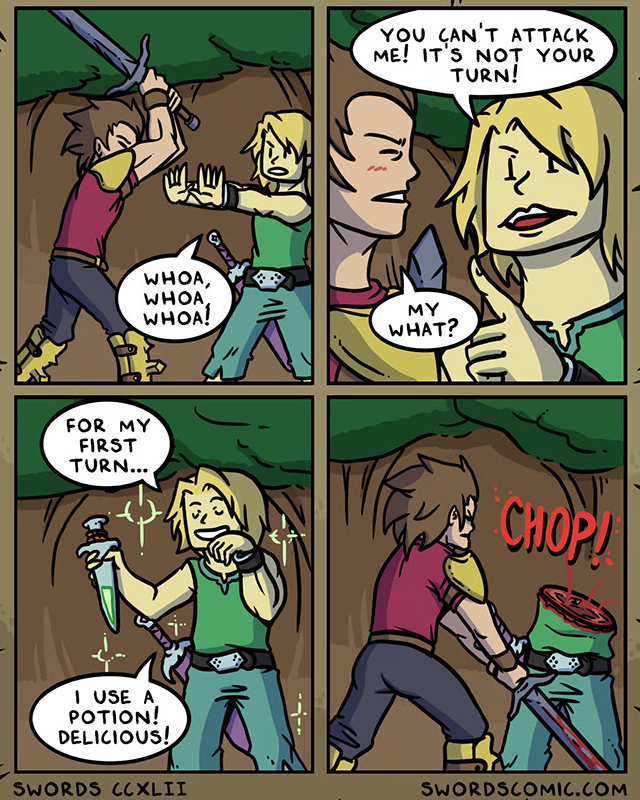
The agony of waiting for an opponent to make a move. Comic by Red Hare Studios
Building the MVP
At surface level, creating a computerized opponent that could chat with players seemed simple. Just have the computer say something when something interesting happens! And respond when the player says something!
The difficulty arose when defining moments in which something interesting happens that warrants conversation. Many games have specific cultures regarding when something is verbally noteworthy. For example, in chess, it’s considered bad manners to comment aloud when someone makes an unusual move before its implications are known. On the other hand, sports cultures like soccer encourage chanting, shouting, and even heckling in high-stakes moments of the game.
To answer this, the product team observed Spades tournaments in both Los Angeles and Houston, Texas to understand the patterns behind how real-life Spades players comment during matches. Based on real-life examples, my design partner & I created a system of conditions that warranted dialogue in the game.
To make sure conversations felt natural, lively, and fresh, we used LLM technology to generate multiple variants of a commonly triggered message. For example, in a close game, I programmed the player’s teammate to say “Let’s try to stop them!” in several, suspense-building ways e.g. “We'd better stop them this round!” or “It all comes down to this round.”
For playtesting, I worked with our UI engineer to wireframe & implement the conversation system in a way that placed the most important UI elements close to the bottom of the screen, where the option to chat would remain both accessible (close to the player’s thumb) and also unobtrusive to the main gameplay.
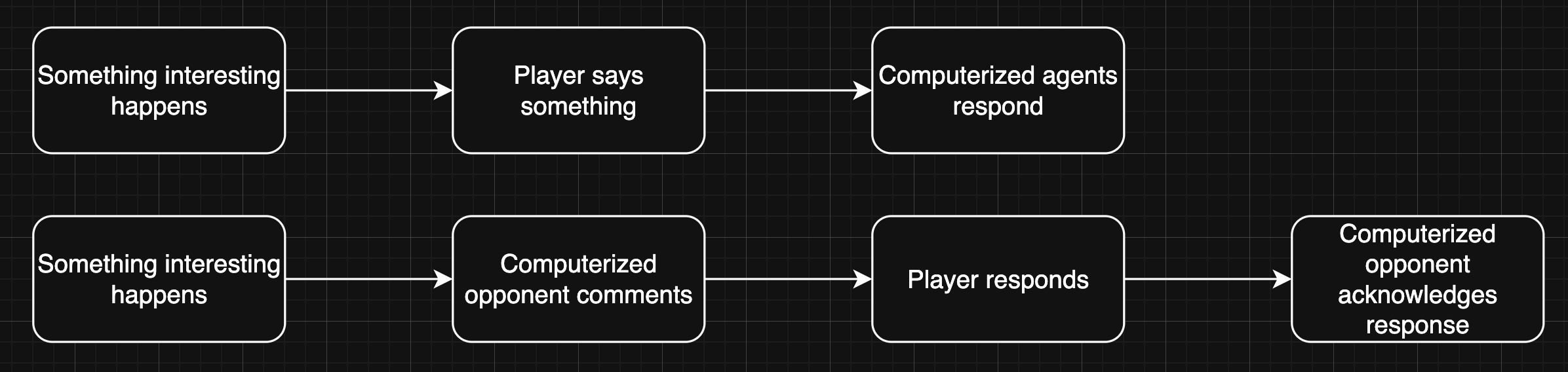
Minimum viable interaction flow for a conversation with a computerized opponent
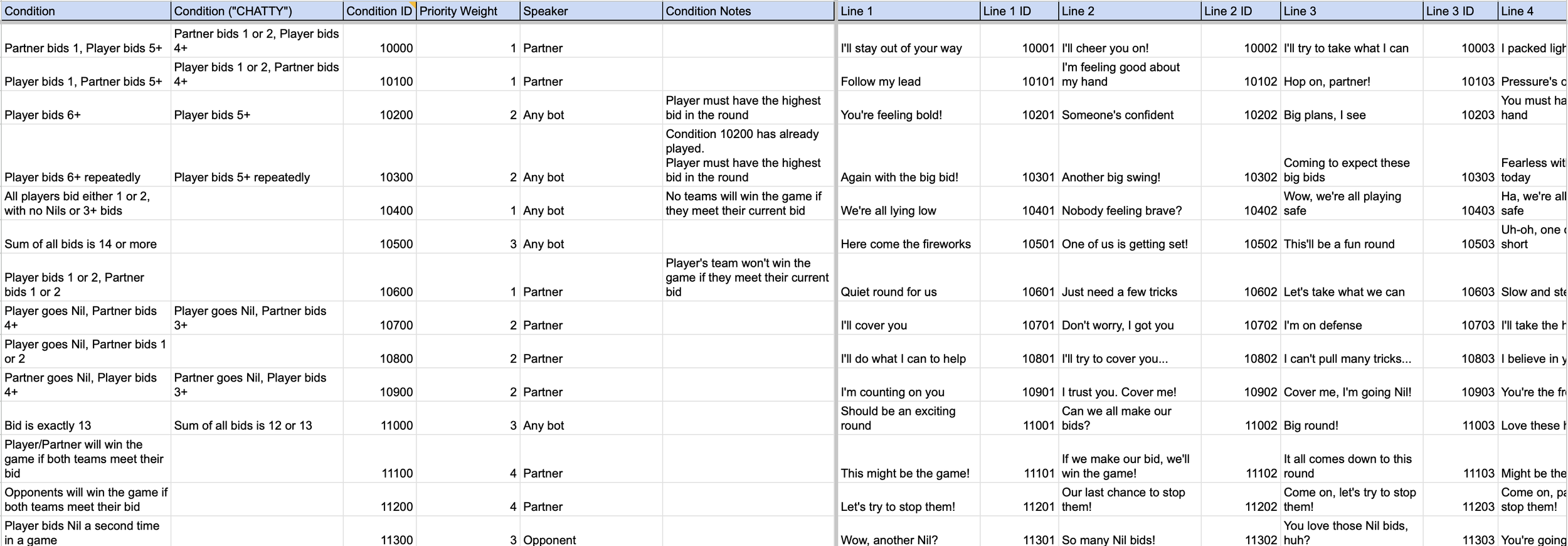
Spreadsheet of conditions that trigger a conversation, plus LLM-powered variations to avoid repeated dialogue
Risks & Tradeoffs
Not everyone wants to trash talk their opponent; some players would prefer a more supportive environment to play cards. Additionally, too much conversation could distract or take away form the core gameplay.
To address this, I implemented the following rules for the tone & frequency of conversations that could happen during gameplay:
Computerized opponent dialogue must be friendly and light-hearted in tone — player teammates are supportive towards the player, opponents are playfully sad when losing, and competitive banter is driven by the player
Computerized opponent-initiated dialogue is limited to 2 messages per round. Players could initiate additional dialogue, if desired.
Players could opt out of chatting entirely
While these rules placed a ceiling on the emotional intensity of in-game chat, they provided a baseline level of support & safety for the majority of our players who may be learning the game, with room to grow as players engaged more with social systems and chats
Results
In AB testing of social systems rollout, adding social systems led to double digit retention & engagement growth
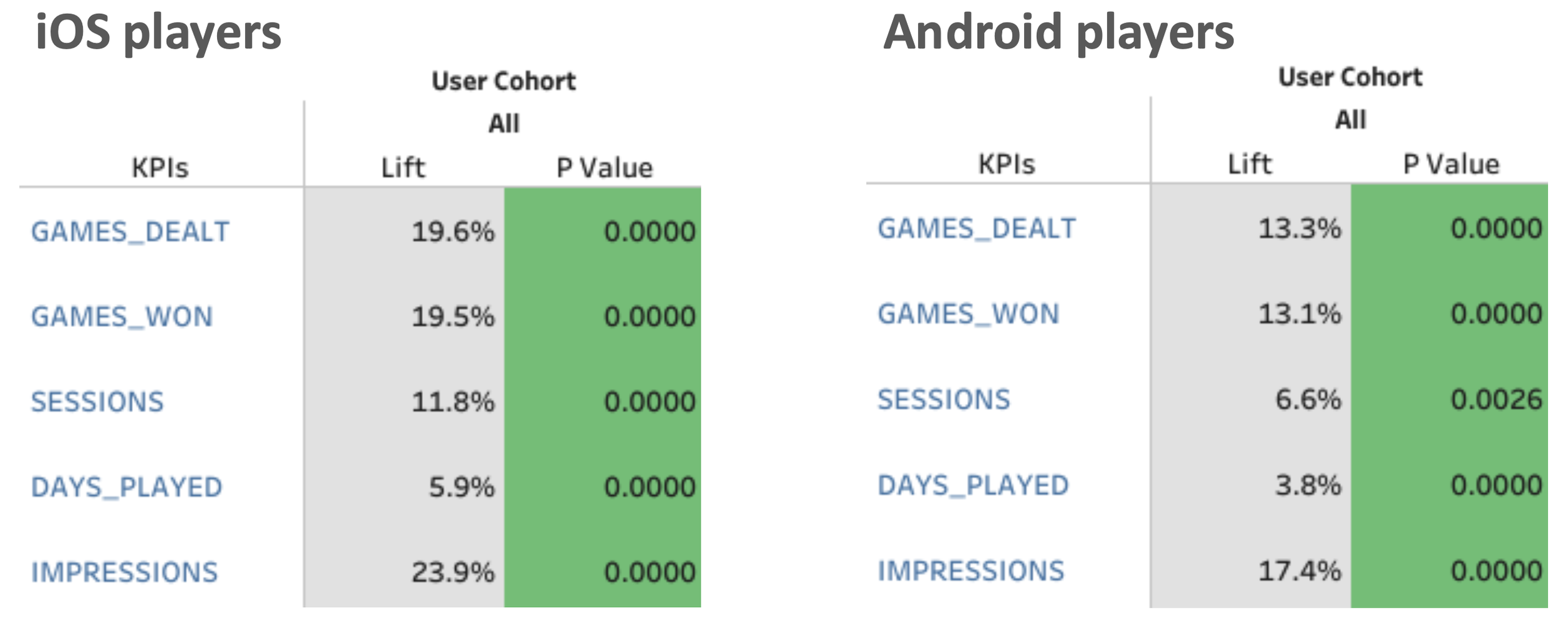
AB test metric results, following the release of social systems in Spades Mobile
In qualitative feedback, players reported in reviews and messages with customer support their desire to continue using the feature and continue chatting with their teammates. Less than 1% of players opted out of the feature
Learnings
Game makers can glean important insights from player communities — returning to the in-person cards playing experience and keying in on the key, fun moments led the Spades Mobile team to a golden opportunity to heighten the fun in the digital experience. The success of social systems in our game led to the Chess.com team rolling out a similar system in their own game, with similarly positive results in the digital chess community.
Moreover, game makers can also identify player needs by understanding the context of a player’s game session in their daily lives. Through user interviews, we uncovered that players often came to Spades Mobile to seek connection. Building a system that provided the feeling of a supportive Spades-playing community was the second-best solution to a real, in-person community — something that is increasingly more difficult to find — and provided comfort for socially isolated players. By understanding our player personas and specific needs, the Spades Mobile team was able to extrapolate the core design pillars of our audience and build a seamless chat experience for those players.
We were able to expand our social system not just to Spades Mobile, but our other competitive card and puzzle offerings and in different languages. In total, we reached over 25 million players and grew studio retention by 8%.